
Gayle King’s Space Flight Sparks Outrage – But Her Epic Clapback Is Truly Out of This World!

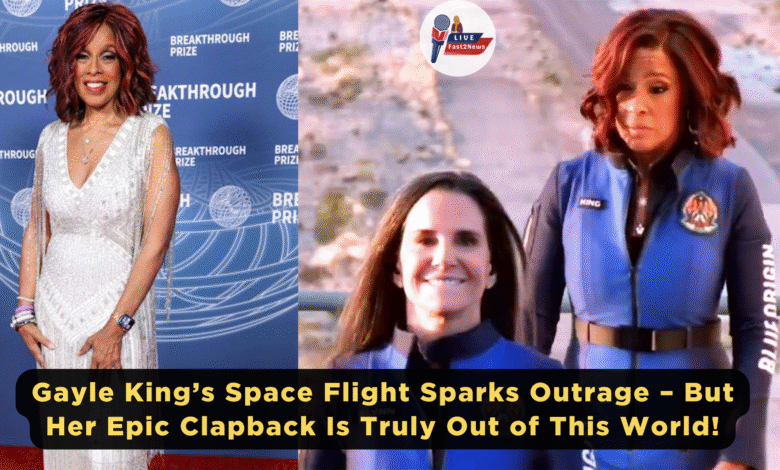
Gayle King Breaks the Internet With Her Space Trip — And the Drama That Followed
In a move that quite literally sent her career into orbit, Gayle King made headlines after boarding a Blue Origin space flight alongside Katy Perry and Lauren Sánchez. The journey, meant to celebrate women in aeronautics, turned into a firestorm of controversy — and oh boy, the shade came fast and furious!
From Hollywood stars to Twitter critics, many questioned the purpose (and cost) of the eight-minute joyride into space. But did Gayle King crumble under pressure? Absolutely not. Instead, she offered a masterclass in clapping back — intelligently, respectfully, and with a smile that said, “You wish you were this fabulous in zero gravity.”
🌍 From Earth Doubter to Space Believer
Before becoming a part of the elite “I’ve-been-to-space” club, Gayle King admits she was one of those skeptics herself.
“I used to wonder, why spend so much on space when there’s work to be done on Earth?”
But like a plot twist in a Netflix documentary, her perspective changed after she learned about Blue Origin’s deeper mission — including efforts to use space innovation to improve life back home.
GPS? Satellites? Global communications? Yup, space tech touches nearly every part of our daily lives. As Gayle put it, “We use space technology all the time.” Every flight isn’t just a luxury, it’s data collection for global solutions.
🚀 The “Expensive Ride” That Wasn’t Just a Ride
Critics were quick to call it a “ride” — as if Katy Perry had booked it on a whim via Uber Space. But Gayle King wasn’t having it.
“You never hear people call a male astronaut’s mission a ‘ride.’ Why call ours that?”
Let’s be real — if Tom Hanks or Elon Musk had been on that flight, the headlines would’ve screamed “heroic mission” or “historic voyage.” But when it’s a group of accomplished women? Apparently, it’s a “ride.”
The trip itself was aboard Blue Origin’s New Shepard rocket, which crossed the internationally recognized boundary of space (62 miles above Earth). Passengers experienced several minutes of weightlessness and a view of our planet that Gayle King called “life-changing.”
🎤 Critics, Celebs & the Art of Throwing Shade
Of course, Hollywood couldn’t keep quiet. Olivia Munn labeled the journey “gluttonous.” Amy Schumer, Emily Ratajkowski, and Olivia Wilde also chimed in — all seemingly forgetting the positive intent behind the mission.
But Gayle? She had her air-tight comeback ready.
“Go to Blue Origin. Learn what they do. Then come back and tell me it’s a waste.”
She didn’t just throw shade back — she turned it into a solar panel and powered through with grace.
👑 Owning the Moment — Haters Included
Gayle King could’ve easily let the negativity dampen her post-space glow. But she chose joy instead.
“Some of the people throwing shade are my friends! But I won’t let them steal my joy.”
Now that’s the energy we need in 2025: unapologetically joyful, unbothered by critics, and floating just slightly above the noise — figuratively and literally.
📡 A Space Trip With a Purpose
Let’s get one thing clear — this wasn’t a vacation. This was a high-profile opportunity to:
-
Inspire women in science and tech
-
Raise awareness about space innovation
-
Highlight how space missions contribute to Earthly problems
Not to mention, give young girls everywhere a glimpse of what’s possible.
If anything, Gayle King’s flight was a modern statement: Women belong everywhere — including space.
📊 Why This Matters More Than Ever
In an age where misinformation spreads faster than a TikTok trend, Gayle King reminds us that doing your homework (or due diligence, as she says) is more important than ever. Instead of judging headlines, maybe we should start exploring what’s behind the launchpad — literally and metaphorically.
💫 Final Thought — Before You Judge a Space Flight, Try Floating in Zero Gravity
So before we roll our eyes at another celebrity doing something “extra,” let’s ask ourselves: Have we ever been to space? Have we seen Earth from above?
Because if not… maybe, just maybe, Gayle King has a point.
🤔 Funny Question for Readers:
If given the chance to go to space like Gayle King — but you can only bring ONE snack — what would it be and why? (Asking for a friend… who’s floating away with Doritos.)
Get the Latest News, Hindi News, English News & Breaking Updates! Please stay connected with us on Facebook, Instagram, Twitter, YouTube, LinkedIn, and reach out. Don’t miss out on real-time updates—follow us now! 🚀 #LatestNews #HindiNews #EnglishNews #BreakingUpdates #Breakingnews
Thanks for reading l Fast2News
